
On September 9, 2025, the Florida Department of Transportation (FDOT), pursuant to 23 U.S.C. §327 and a Memorandum of Understanding dated May 26, 2022, and executed by the Federal Highway Administration and FDOT, was granted Location and Design Concept Acceptance for the Interstate 75 (I-75) Project Development and Environment (PD&E) Study from Moccasin Wallow Road to south of US 301 (WPI Seg. No. 419235-2).
The environmental review, consultation, and other actions required by applicable federal environmental laws for this project are being, or have been, carried out by the Florida Department of Transportation (FDOT) pursuant to 23 U.S. C. §327 and a Memorandum of Understanding dated May 26, 2022 and executed by the Federal Highway Administration and FDOT.
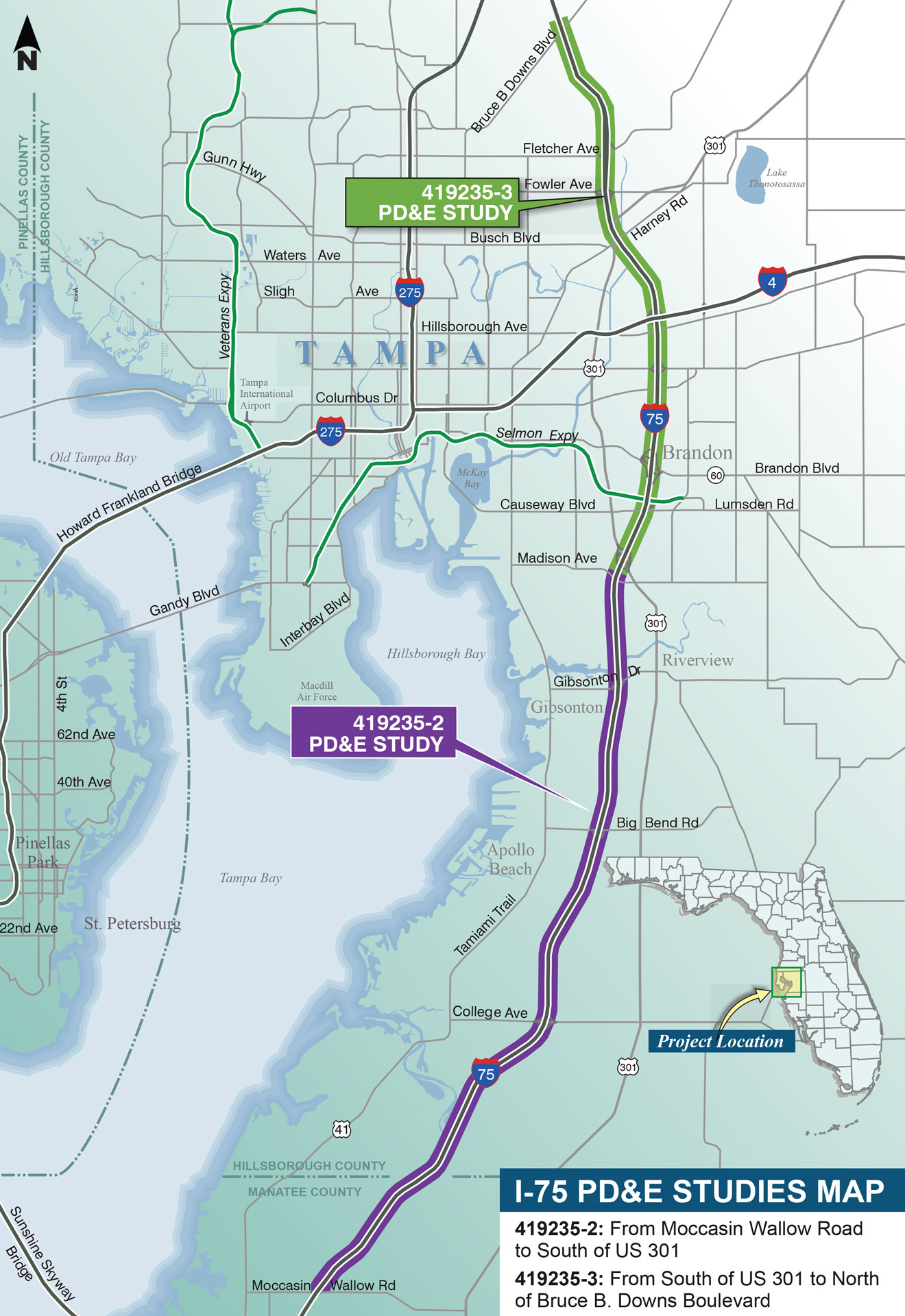
The Florida Department of Transportation (FDOT), District Seven, has conducted two Project Development and Environment (PD&E) Studies to evaluate capacity improvements along approximately 41 miles of Interstate 75 (I-75)/State Road (SR) 93A. The Southern PD&E Study is approximately 23 miles long and runs from Moccasin Wallow Road/County Road (CR) 6 in Manatee County to south of US 301 in Hillsborough County as Work Program Item (WPI) Segment No. 419235-2. The Northern PD&E Study is approximately 18 miles long and continues from south of US 301 to north of Bruce B. Downs Boulevard in Hillsborough County under WPI Segment No. 419235-3. The design year for the improvements is 2045.
The objective of these PD&E Studies is to assist the FDOT Office of Environmental Management (OEM) in reaching a decision on the type, location, and conceptual design of the necessary improvements for I-75 to safely and efficiently accommodate future travel demand while minimizing impacts to the environment, consider agency and public comments, and ensure project compliance with all applicable federal and state laws. Type 2 Categorical Exclusion documents are being prepared as part of these studies. These PD&E Studies will document the need for the improvements as well as the procedures utilized to develop and evaluate various improvement alternatives including elements such as proposed typical sections, special designation of travel lanes, preliminary horizontal alignments, and interchange enhancement alternatives. The anticipated social, physical, and natural environmental effects and costs of these improvements will be identified. The alternatives were evaluated and compared based on a variety of parameters utilizing a matrix format. This process will assist in identifying the alternative that will best balance the benefits (such as improved traffic operations and safety) with the impacts (such as environmental effects and construction costs).
These PD&E Studies satisfy all applicable requirements, including the National Environmental Policy Act (NEPA), to qualify for federal-aid funding of subsequent development phases (design, right-of-way acquisition, and construction).
The Florida Department of Transportation (FDOT) has conducted two Project Development and Environment (PD&E) studies that considered improvement options on Interstate 75 (I-75) (State Road 93A) in Manatee and Hillsborough Counties. A map detailing the limits of both projects is shown on this page. The northern project (shaded green) extends from south of US 301 to north of Bruce B. Downs Boulevard, a distance of approximately 18 miles. The southern project (shaded purple) extends approximately 25 miles from Moccasin Wallow Road to south of US 301.
I-75 is part of the Strategic Intermodal System (SIS). Currently, I-75 generally has six travel lanes (three northbound lanes and three southbound lanes). I-75 is a major corridor that, in addition to serving intrastate travel and evacuation needs along the west coast of the state, also supports commuting, trade and tourism activities within the Tampa Bay region. Traffic congestion, which motorists currently experience along portions of I-75, is anticipated to worsen as traffic is expected to grow into the future. Improvements will be necessary to ensure I-75 operates efficiently and meets regional mobility needs. The improvements will relieve traffic congestion on I-75, improve safety and emergency evacuation, and reduce emergency response time.
These PD&E studies identified and analyzed various alternative design concepts to meet the future traffic needs on I-75. These studies evaluated the environmental effects of the alternatives. The mainline widening improvements will generally be situated within the existing right-of-way. Additional right-of-way will be needed for stormwater management facilities, floodplain compensation sites, and interchange access improvements.